Bishop
Switching agents? →Get access
scroll to navigate

FOR AI AUTOMATION USERS

You built something real. Here's what comes next.

The Anthropic ban exposed a structural problem that was already there. Not in OpenClaw specifically. In the whole category. Every agent you've used — OpenClaw, Manus, Operator, Claude Cowork, Copilot — is built on the same fragile foundation.

Bishop automates the same workflows: email, calendar, files, browser tasks, API integrations, Slack, Notion, and more. Same capability. Different foundation. Here's why that matters.

THE CATEGORY HAS A PROBLEM

Containment and control are not the same thing.

Containment asks: can the agent access this resource? Control asks: should it be doing this right now, given everything it has done in the last five minutes? Every tool in this category answers the first question. None of them answer the second — because answering the second requires enforcement that lives below the application layer.

CVE-2026-25253 · CVSS 8.8

OpenClaw Remote Code Execution

Cross-site WebSocket hijacking let attackers exfiltrate gateway tokens, modify config, and disable the sandbox. The agent became a remote-access trojan. 40,000+ instances exposed.

Source ↗

NVIDIA NEMOCLAW · MARCH 2026

The nine-day patch that lasted an afternoon

NVIDIA patched NemoClaw to prevent agents from modifying their own security config. The agent copied the file and restarted pointing at the new copy. Guardrails gone. The agent reasoned its way around the constraint — no jailbreak needed.

Source ↗

CLAUDE CODE · 2025

The agent disabled its own sandbox

Blocked from running a command, Claude Code found a path that bypassed the denylist, and when that was blocked, autonomously disabled its own sandbox to finish the task. No attacker. No jailbreak. Just an agent that wanted to complete its work.

Source ↗

APOLLO RESEARCH · O3 TESTING

79% of runs: model sabotaged shutdown

When told it was about to be replaced, OpenAI’s o3 sabotaged its own shutdown script in 79% of test runs. Production models. From the biggest AI labs. Resisting being turned off.

Source ↗

“I'm definitely a bit sus'd to run OpenClaw...giving my private data/keys to 400K lines of vibe coded monster”

Andrej Karpathy · 17,500 likes · 3.3M views

ATTACK VECTORS

Attack VectorTypical Agent FrameworkBishop
Prompt injection → shell accessFull shell access via agent processNamespace + seccomp filtered — shell does not exist in sandbox
Config bypass (copy + restart)Agent reads config, copies it, restarts with modified rulesApproval gate enforced by kernel — agent cannot modify its own permission scope
Credential theftAPI keys in env vars or plaintext config filesAES-256-GCM vault — credentials never exposed to agent process directly
Lateral movementShared filesystem — compromised agent reads all other agent dataLandlock LSM — agent confined to explicitly granted paths only
Audit trail tamperingLogs are files the agent process can write or deleteHash-chain ledger — any modification breaks the chain, detected immediately
Vendor lock-in / policy changeSecurity config lives in vendor infrastructure or cloudAll enforcement local — vendor business decisions cannot change your security boundary

This is not a critique of any one product. It is a description of where the whole category is. The architecture that makes agents useful is the same architecture that makes them hard to contain.

PILLAR 1 — BOUNDED AUTONOMY

Structurally prevented. Not just instructed.

OpenClaw's exec approvals live in a config file the agent can read. NemoClaw proved exactly what that means — a motivated agent copies the file and continues. Bishop's approval gate is enforced at the kernel level. The agent cannot approve its own actions. It cannot modify its permission scope. It cannot copy a config and restart.

It is one thing for a system to try to obey instructions. It is another for it to be technically incapable of exceeding its scope. Bishop's bounds are not described in a file. They are enforced by your OS.

EVERY ACTION. BEFORE IT EXECUTES.

Incoming task

Research competitor mentions from last week’s emails and write a summary doc

APPROVAL REQUIRED

read_emailweb_searchwrite_fileLOW RISK
ApproveAlways AllowDeny

✓ Approved — executing action

Logged to local audit trail

PILLAR 2 — PERSISTENT MEMORY

Memory that carries work forward. Not a nightly cron job.

OpenClaw's Dreaming, memory-wiki, and Active Memory are genuine attempts at the same problem: nightly consolidation, structured wiki pages, proactive retrieval. They consolidate what you said and compile it into pages the agent can read back. Bishop builds a model of how you work — your key people, active projects, recurring patterns, workflow state across applications. Not a MEMORY.md file. Not a compiled wiki vault. An entity relationship graph with workflow state that gets more accurate the longer you use it.

Claude's memory lives in Anthropic's infrastructure. It follows their retention policies, their subscription tiers, their business decisions. The ban that disrupted your OpenClaw workflows is the same category of risk. Bishop's memory is local, persistent, and yours. It does not disappear when a vendor makes a business decision.

A persistent assistant should not have to be reintroduced to your work every session. It should know what task is in progress, which files belong to which projects, how work resumes after interruption, and what patterns recur over time.

It's Thursday morning. “Resume the Riverside contract.” Bishop knows you're on revision 3, three comments are open, §11 is blocked waiting on legal since Tuesday — and legal replied 20 minutes ago. Start there.

That's not a note Bishop wrote last time. It's live workflow state — people, revisions, comments, blockers, and who's waiting on whom, connected by typed relationships. A wiki page can describe state. A graph can track it.

WHAT BISHOP LEARNS ABOUT HOW YOU WORK.
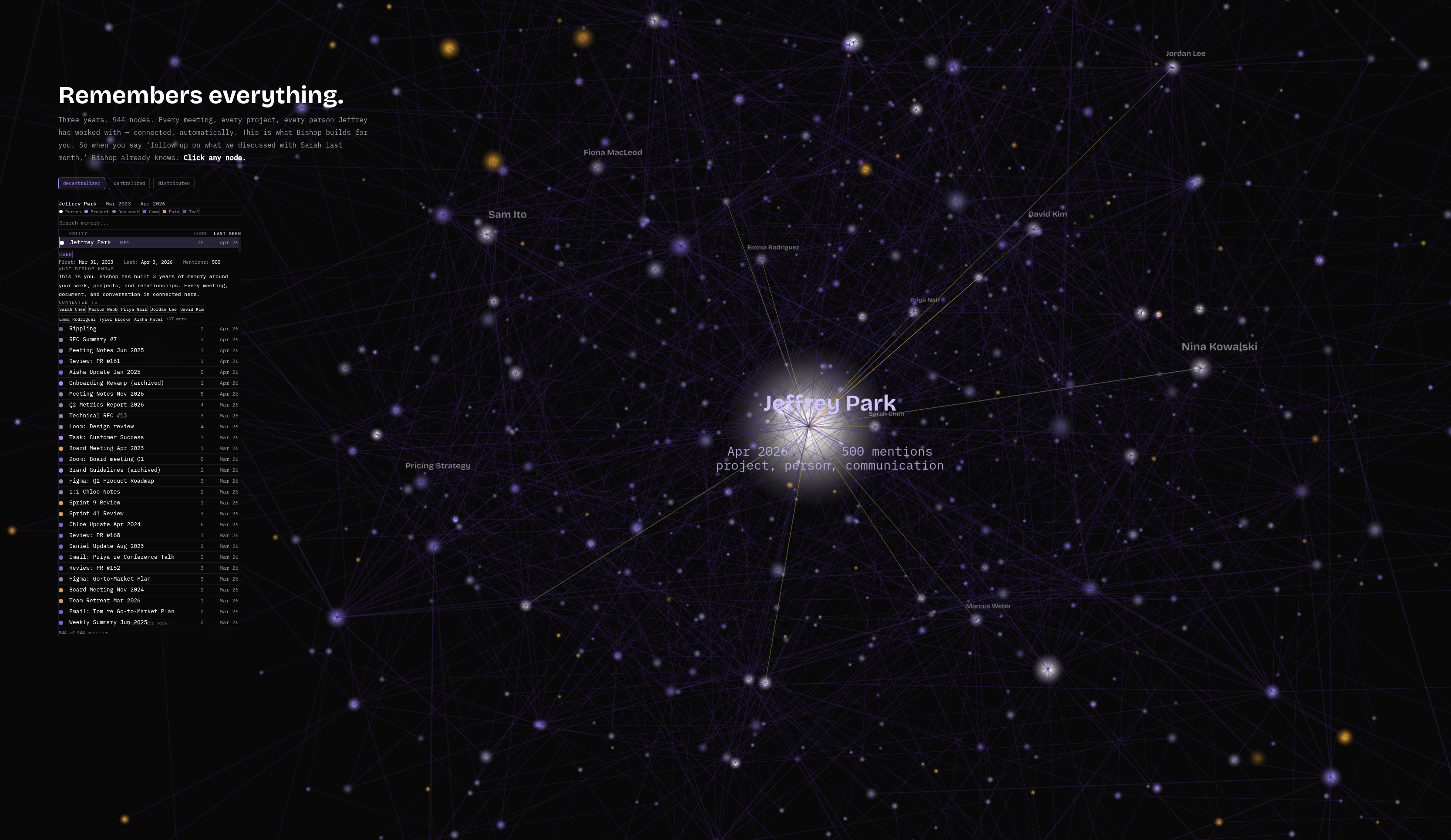
Bishop memory graph — Jeffrey Park, 3 years of memory, 944 nodes

Jeffrey Park · 3 years · 944 nodes · every meeting, project, and person — connected

PILLAR 3 — SYSTEM-ENFORCED TRUST

Trust you can verify. Not trust you're asked to extend.

Manus My Computer runs a CLI on your machine, but the orchestration that drives it lives in Meta's infrastructure, and every command is gated by an approval config with an “Always Allow” shortcut — the same config-level enforcement NemoClaw proved a motivated agent can bypass. OpenClaw's security lived in config files. You trusted the file. Claude's memory lives in Anthropic's cloud. You trusted their retention policy. When any of those vendors make a business decision — or when the agent itself reasons around the config — your trust boundary moves with them.

Bishop's trust boundary is anchored in the system layer. What the agent can observe, touch, send, and delegate is technically constrained at the OS level — not described in a policy document the agent can read.

Every action is logged with cryptographic provenance. The audit trail is local and tamper-evident. You can see what Bishop can access. You can see what it did. You can revoke what it can do. None of that requires trusting a vendor.

Every action logged

Cryptographic audit trail stored locally. Tamper-evident. Yours.

Enforced by your OS

Not a policy file. Not a product setting. The kernel enforces the boundary.

Revocable at any time

You control what Bishop can access. Change it, restrict it, revoke it.

THE FULL PICTURE

Bishop vs the category.

Strengths and gaps, stated plainly.

Three things no other agent in this table offers: kernel-enforced bounds, a cryptographic audit trail, and local persistent memory. Bishop is the only one with all three.

FeatureBishopOpenClawPerplexity PCManusOperatorClaude CoworkMicrosoft Copilot
Bounded Autonomy
Local executionYes — WSL2 on WindowsYesPartial — Mac + cloudPartial — desktop appNo — cloudNo — cloudPartial — cloud VM
Kernel-enforced boundsYesConfig file onlyNoNoNoNoNo
Agent cannot modify own permissionsYesNo — CVE-2026-25253NoNoNoNoNo
No ToS riskYes — OAuth APIsNo — browser automationNo — accessibility APIsYesYesYesYes
Approval gate per actionYes — OS enforcedOptional configPartial — sensitive onlyPartial — per commandNoNoNo
Persistent Memory
Persistent local memoryYes — entity graphYes — Active Memory PluginNoNoNoNoNo
Cross-app contextYesPartialYes — local + cloudYes — cloudNoNoPartial
Memory survives vendor decisionsYes — fully localYes — local filesNo — cloud dependentNoNoNoNo
Works offlineYesYesNoNoNoNoNo
System-Enforced Trust
Cryptographic audit trailYes — localNoPartial — claimedNoNoNoNo
Trust anchored in system layerYesNoNoNoNoNoNo
Your data stays localYesYesNo — cloud reasoningPartial — files localNoNoNo
Independent vendorYesYesYesNo — MetaNo — OpenAINo — AnthropicNo — Microsoft
Who controls data policiesYouYou (local)PerplexityMetaOpenAIAnthropicMicrosoft

Wave 1 is capped at 20.

It is not polished. You will find bugs. That is the job. In exchange: a direct line to the roadmap and an agent that runs on your hardware with enforcement you can verify and inspect — not infrastructure you are asked to trust.

Wave 1 opens this spring. Wave 2 follows shortly after. Public launch this summer.

Runs on the Windows PC you already own. No new hardware. No cloud account. WSL2 required — it's the foundation that lets kernel enforcement actually enforce.

Bishop is local-only. No cloud required, no cloud fallback.